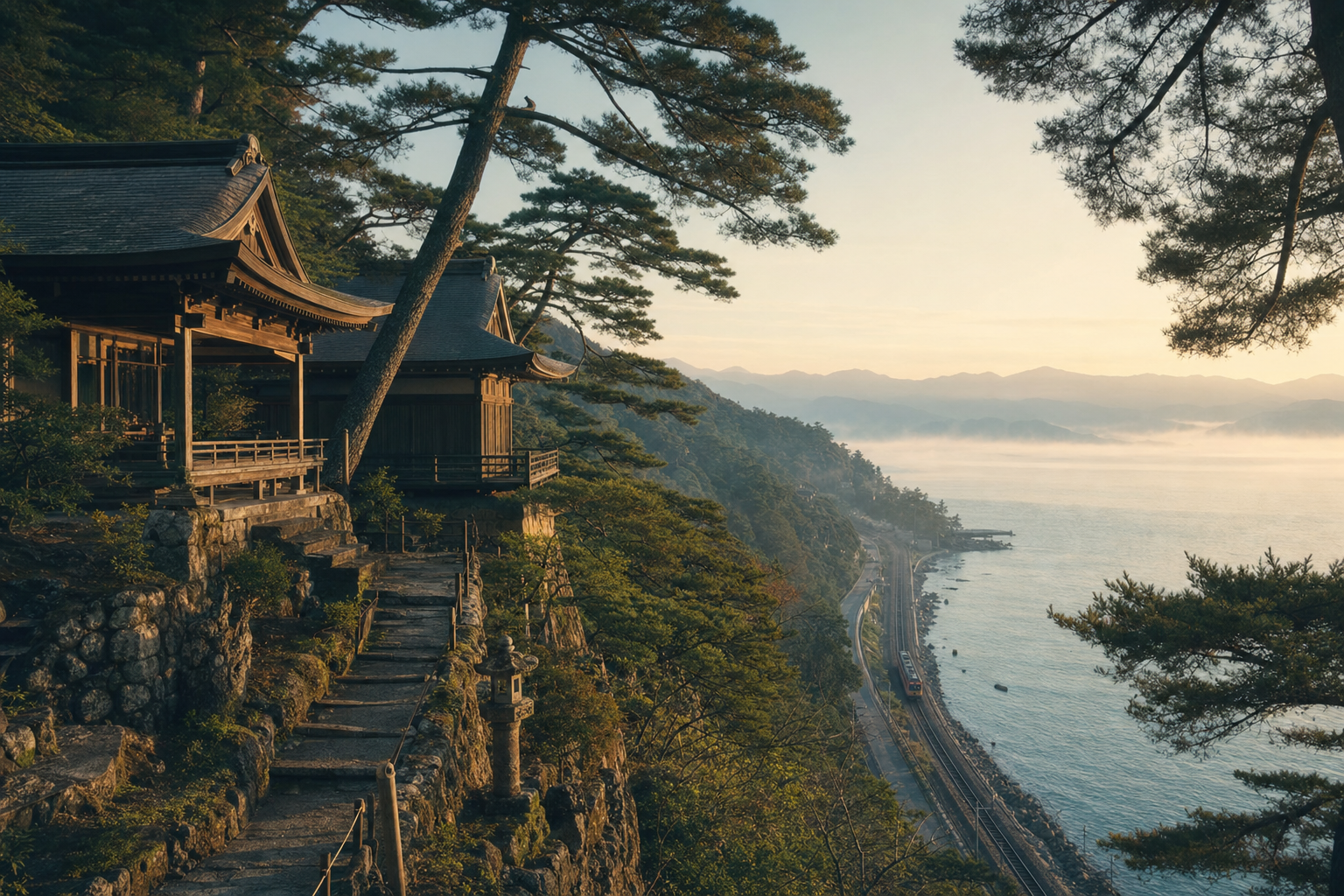
Early morning in Okitsu, and the first sound is not the sea. It is the train. The Tokaido Main Line runs along the narrow shelf of land between the mountains and Suruga Bay, and at Seikenji temple it does something almost unbelievable: it passes straight through the temple grounds, between the old gate below and the main halls above. You climb the stone steps, a local train hums past beneath your feet, and then the quiet returns — pine branches, the smell of incense, and beyond the rooftops, the wide grey-blue of the bay.
It sounds like an intrusion. Stand there for a few minutes and it starts to feel like the opposite. The road has always run through this temple's front yard. First the walkers, then the palanquins, then the rails. Seikenji simply kept its seat and watched.
A temple at the narrow place
Okitsu was the seventeenth post station on the Tokaido, the great road between Edo and Kyoto. Travelers coming from the east had just crossed Satta Pass, where the trail climbed high above the water — the view Hiroshige made famous, with Mount Fuji floating over the bay. Coming down from that pass, tired and wind-blown, they arrived at Okitsu-juku: inns, teahouses, the smell of grilled fish, and on the hillside above the road, the tiled roofs of Seikenji.
The temple is far older than the post town's Edo-period heyday. This stretch of coast was a strategic narrow place for centuries — whoever held it controlled passage along the sea road — and a temple here was never going to be a hermitage. Seikenji grew up as a Rinzai Zen temple with its face turned toward the traffic. Its halls look out over the bay toward the pine groves of Miho no Matsubara, and its steps come down almost to the road itself.
The boy who studied here
In the mid-1500s, a small boy was sent up those steps to study. He was a hostage of the Imagawa clan, which then ruled this coast, and his childhood name was Takechiyo. At Seikenji he received his early education under the guidance of the temple's monks. The boy grew up to become Tokugawa Ieyasu, the man who unified Japan and founded the shogunate that would rule for two and a half centuries.
Ieyasu never forgot this coastline. When he gave up the title of shogun, he retired not to Edo but to nearby Sunpu — today's Shizuoka City — a short ride from the temple where he had learned to read as a captive child. The temple's garden is traditionally associated with him, and the connection was clearly a point of pride: under the Tokugawa, Seikenji flourished as one of the notable temples of the Tokaido.
Guests from across the sea
Seikenji's most remarkable visitors came from abroad. During the Edo period, Korea's Joseon dynasty sent grand diplomatic missions — the tsushinshi — along the Tokaido to the shogun's court, processions of hundreds of officials, scholars, musicians, and calligraphers. Seikenji was one of their stopping places, and the envoys left behind what diplomats of that age left best: brushwork. Plaques and calligraphy from the Korean missions still survive at the temple, written in praise of the view over the bay.
It is worth pausing on that. In an era we often describe as "closed," a temple on the Japanese coast was hosting foreign scholars who looked out at Suruga Bay and reached for their brushes. The old road was never only a domestic road. It was where Japan met its guests.
What the temple still does
Later, in the Meiji era and after, Okitsu became a quiet retreat for statesmen; the elder politician Saionji Kinmochi kept his seaside villa, Zagyoso, here. The pattern held for centuries: people who had carried heavy responsibilities came to this stretch of coast to set them down.
Today Okitsu is part of Shizuoka City, and the old post town survives in fragments — a stone marker, a bend in the street that follows the original road. But Seikenji still does exactly what it has always done. It sits above the traffic, keeps its garden, rings its bell, and offers anyone who climbs the steps the same reward it offered a hostage boy and a Korean envoy: a long, unhurried look at the sea.
Walking it yourself
The temple pairs naturally with a half-day on foot. Walk the old Tokaido over Satta Pass from the Yui side — the trail through the mandarin orange groves still frames the bay the way Hiroshige drew it — and come down into Okitsu as travelers always did, finishing at Seikenji's steps. Time it for late afternoon, when the light goes gold on the water and the trains below the temple catch it like a moving thread.
Every old road has a place that watched it longest. On the Tokaido, that place may be here. If this stretch of coast calls to you, it makes a gentle first chapter for a journey along the old sea road — and a good place to ask yourself, with the bay in front of you, what the Way means to you.