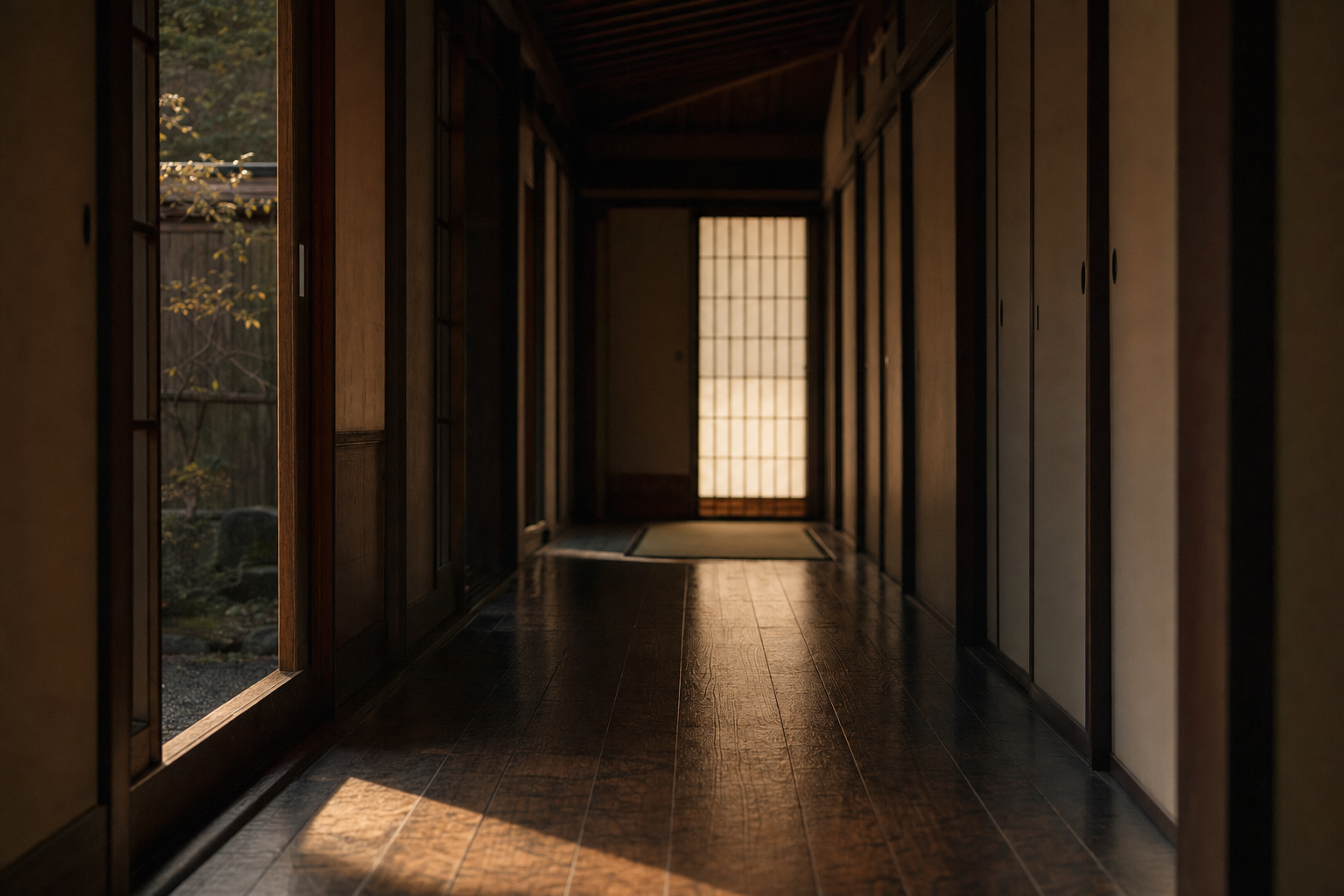
Early evening in an old ryokan. The corridor is long, the wood dark with a century of polishing, and there is almost nothing in it. A single flower in an alcove. A lantern. Your own footsteps, softened by socks on cedar. You walk slowly without being told to, and by the time you reach your room, something in you has already changed pace.
That corridor was not left empty by accident. It is doing work. In Japanese, the word for what it is doing is 間 (ma) — the interval, the gap, the space between things.
A word you can see and hear
Ma is one of those words that resists a single translation because it lives in so many places at once. It is spatial: the distance between stones in a garden path, the blank paper around a few strokes of ink. It is temporal: the pause between notes in a piece of shakuhachi music, the beat of silence before a Noh actor moves. The written character itself tells a small story — a gate (門) with light coming through the opening. Ma is not the gate and not the light. It is the opening that lets one meet the other.
Western design often asks: what should we put here? Ma asks the opposite question: what should we leave out, so that what remains can breathe?
The tea room: two mats and a pause
Step into a traditional tea room and the first thing you notice is how little there is. A small space, often just a few tatami mats. One scroll. One flower. The host does not rush. Water is ladled, and there is a pause. The whisk moves, and there is a pause. Guests who are new to tea sometimes find these silences awkward — until, somewhere in the second or third pause, they stop waiting for the next thing to happen and begin to notice what is already happening: steam rising, the sound of water, the person across from them.
The tea masters understood something practical about attention. If every moment is filled, nothing stands out. The pause before the bowl is offered is what makes the offering feel like an offering. Ma is not the opposite of hospitality. It is hospitality's quietest form.
The dojo: distance as a living thing
In Japanese swordsmanship, there is a related word: maai (間合い) — the combative distance between two people. Watch two practitioners of kendo or iaido face each other and you will see that the real contest happens before anyone moves. Each is reading the interval: one more step and I can reach you; one step back and you cannot reach me. The space between the swords is not empty at all. It is charged, alive, constantly negotiated.
Teachers often spend years correcting not a student's cut but their distance. Too close, and technique collapses into scrambling. Too far, and nothing connects. The lesson travels well beyond the dojo floor: knowing how near to stand, how long to wait, when to speak and when to let a silence hold — these are all questions of ma.
Why the old inns understood this
The ryokan corridor, the tea room, and the swordsman's stance all rely on the same quiet principle: meaning needs room. The innkeepers along the old post roads knew it in their bones, even if they never named it. A traveler arriving off the Nakasendo after a long day of walking did not need more stimulation. They needed a threshold — a place where the road's noise could fall away before the meal, before the bath, before sleep. The empty corridor was the exhale between the journey and the rest.
Modern travel often works against this. We fill every gap: the podcast on the train, the phone at the table, the itinerary with no blank afternoons. Nothing is wrong with any of it. But a trip with no ma is like a sentence with no spaces — all the words are there, and none of them can be read.
Carrying one word home
You do not need a tea license or a sword to practice ma. Leave one evening of a journey unplanned and see what fills it. Sit in a room for five minutes before unpacking. In conversation, let a silence last one breath longer than feels natural, and notice that the other person often says the truer thing next.
At KAIDO, when we walk the old roads and stay in the old towns, this is part of what we are looking for: places that still know how to leave space — in a corridor, in a schedule, in a day. The Way is not only the path underfoot. It is also the intervals along it, the pauses that let a journey become something you actually felt.
What does the Way mean to you? Perhaps, this month, it means the part you leave empty.