The kendo hall smells of polished wood and old cotton. It is early, and the floor still holds the cold of the night. Two students face each other, bamboo swords raised. One steps in, shouts, strikes — a sharp crack against the padded helmet — and then does something a first-time visitor rarely notices. She does not stop. She passes through, turns, and settles back into her stance, eyes still on her opponent, sword still alive in her hands. The strike has landed, but her attention has not ended.
This is zanshin — 残心. Written with two characters: zan, to remain, and shin, the heart or mind. The attention that remains after the action is over.
The point that does not count
In kendo, zanshin is not a decoration. It is a rule. A strike, however clean, is not awarded as a valid point unless the person who made it maintains awareness afterward — correct posture, readiness, eyes on the opponent. Hit and then relax, hit and then celebrate, and the judges will not raise their flags. The tradition is blunt about why: in a real encounter with real swords, the moment after your attack was the moment you were most likely to die. Turning your back on an opponent, even a fallen one, was how skilled people were killed.
Kyudo, Japanese archery, keeps the same idea in slower motion. After the arrow leaves the bow, the archer does not lower her arms and look at the target to see how she did. She holds the follow-through, breathing, arms open, until the shot has fully ended — and the shot is understood to end well after the arrow has landed. The release is not the finish line. It is the middle.
From the dojo to the doorway
What makes zanshin worth carrying out of the dojo is that Japan never left it there.
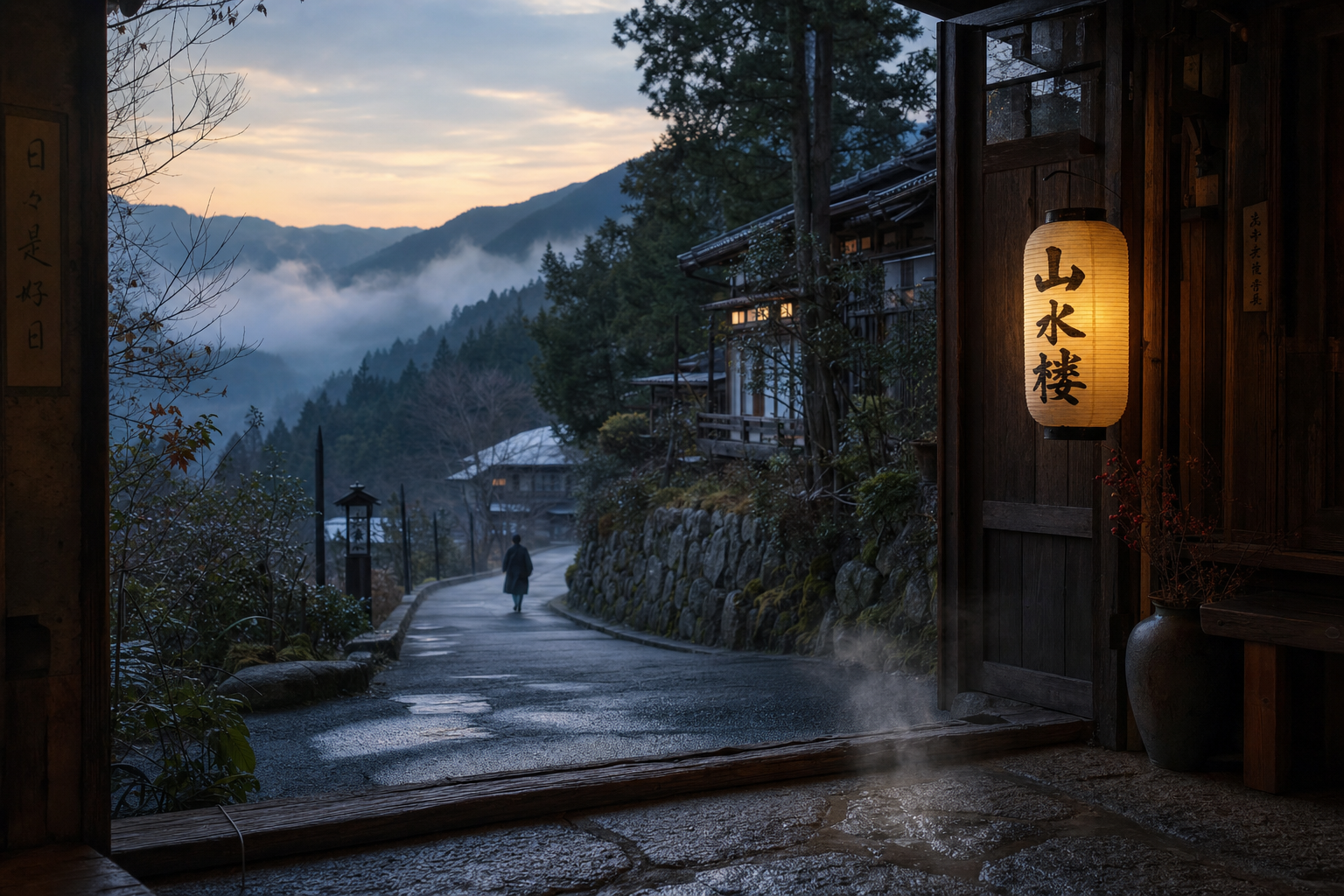
Stay at a family-run ryokan on an old post road and you will meet it on your last morning. You settle the bill, put on your shoes in the entryway, and step out into the street. Behind you, the okami — the woman who runs the house — comes out too. She bows. You walk away, and after twenty steps something makes you glance back. She is still there. She will stand at that door, sometimes with the whole small staff beside her, until you turn the corner and the street takes you out of sight. Only then does the farewell end, and only for her — you never see the moment she goes back inside.
This custom of miokuri, seeing someone off, is zanshin in an apron instead of armor. The transaction is complete. The obligation, strictly speaking, is over. What remains is attention: the host's care extending past the point where it could possibly be repaid or even witnessed. That is exactly the shape of the swordswoman's follow-through. The action has ended; the heart has not.
What the word protects
Tea practitioners speak of a related feeling — that after guests leave, the host does not rush to tidy up, but sits for a moment with the day, letting the gathering finish inside as well as outside. A carpenter sweeps the workshop at the end of the day not because tomorrow's client will inspect the floor, but because the work is not truly done until the space is returned to order. In each case, zanshin protects the same fragile thing: the gap between finishing a task and abandoning it.
Most of us live on the wrong side of that gap. We send the message and immediately open the next one. We say goodbye at the station and are checking our phones before the train doors close. Nothing terrible happens — no opponent strikes us down. But something small leaks away each time: the sense that what we just did, and the person we just did it with, mattered enough to hold for one breath longer.
Trying it on the road
The old highways are a good place to practice, because travel is made almost entirely of endings — leaving an inn, finishing a meal, walking out of a town you will likely never see again. Try the small version: when you leave a place that treated you well, pause at the threshold and look back once, deliberately, before you go. When someone sees you off, walk away knowing they are still standing there, and let that change how you carry the first hundred meters.
It costs a few seconds. What it buys is harder to name — a journey that ends cleanly at each step instead of blurring into the next one.
The strike lands. The guest departs. The heart remains a moment longer. That is zanshin — and if you want to feel it done to you, the surest way is still an old inn, an early departure, and one glance back over your shoulder.
One Word is a KAIDO Journal series that unpacks a single Japanese term through the places and practices where it still lives. If a word like this makes you want to walk the roads where it was coined, our journeys and stays begin there.