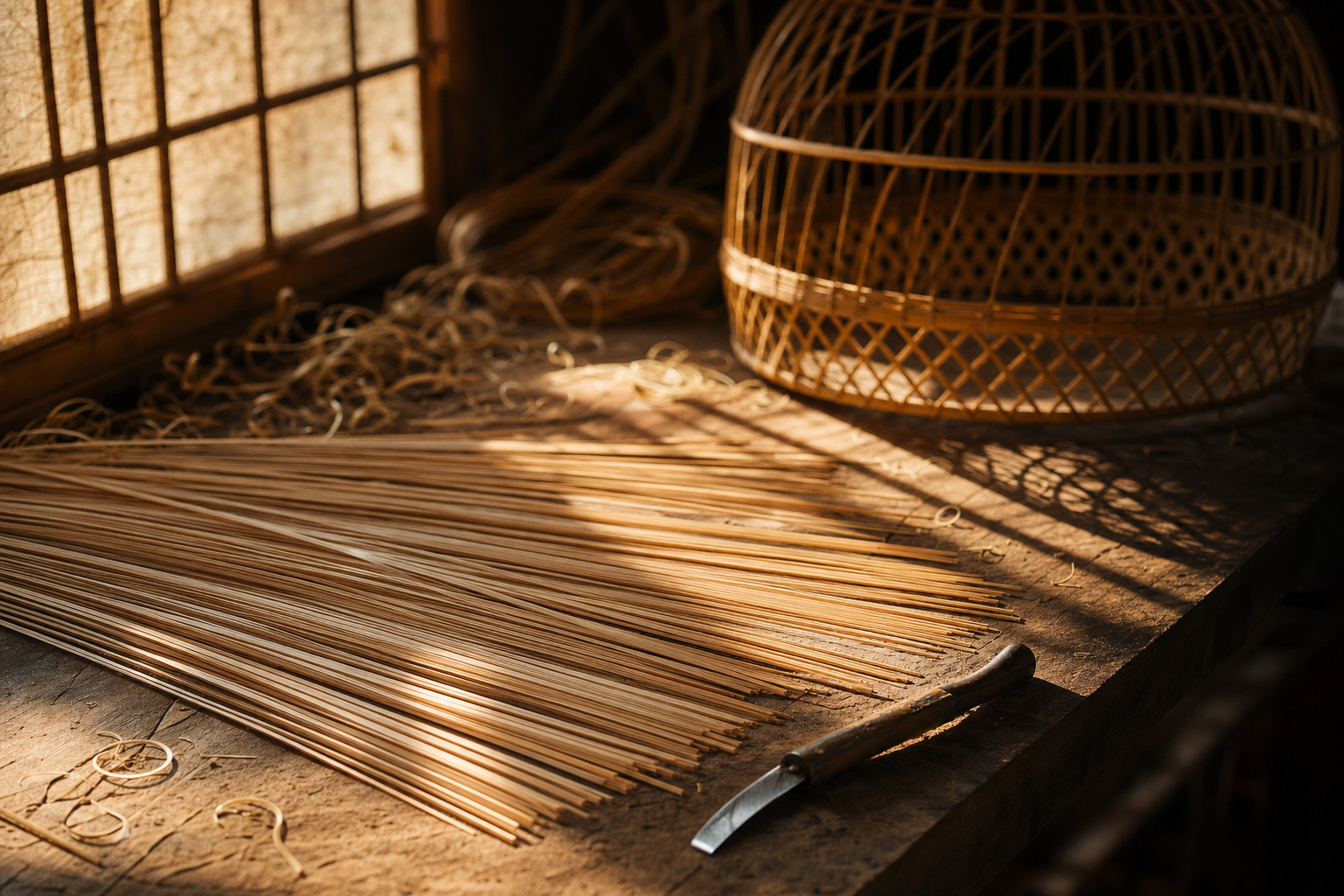
The workshop smells faintly green — cut bamboo has a scent somewhere between grass and rain. On the workbench lies a bundle of strips, each one thinner than a chopstick, some nearly as fine as a strand of straw. The artisan pulls one strip through a small steel plate drilled with holes, again and again, each pass shaving it rounder and thinner. The sound is soft, rhythmic: a whisper, a pause, a whisper. By the end of the morning there will be a hundred strips on the bench. Every one must be identical. If even one is slightly thick, the finished cage will show it — a single crooked line in a wall of perfect verticals.
This is Suruga takesensuji zaiku — Suruga bamboo latticework, the craft of Shizuoka City. The name means, roughly, "a thousand fine lines of bamboo," and once you have seen a finished piece, the name explains itself. An insect cage, a flower basket, a tea tray: each is a small architecture of parallel bamboo threads, so evenly spaced that light passes through them like water through a comb.
A craft born on the road
Shizuoka sits on the old Tōkaidō, the great coastal highway that connected Edo and Kyoto. The castle town here — Sunpu, as it was called — was a busy stop, and bamboo grew thick in the surrounding hills. Bamboo work flourished in this region through the Edo period, and travelers walking the Tōkaidō carried the small, light pieces home as souvenirs: cages for singing insects, baskets, hats. A cage woven from fine bamboo weighs almost nothing. For someone walking two weeks to Edo, that mattered.
What sets the Suruga craft apart from most Japanese bamboo work is the shape of the strip itself. Elsewhere, artisans usually weave with flat strips. Here, the strips — called higo — are milled round, like fine dowels. And instead of being woven, they are inserted one by one into tiny holes drilled along bamboo rings that have been bent into circles over heat. The result looks less like a basket and more like a birdcage drawn with a fine pen. In 1976 the craft was designated a traditional craft of Japan, but its real certification is older: generations of travelers who picked one up, felt how light it was, and bought it.
The patience is the craft
Watch an artisan work and you notice how little of the day is spent on anything that looks dramatic. The bending of a ring over a small flame — the moment the straight bamboo softens and curls — takes seconds. Most of the day is preparation: splitting the bamboo, shaving it, pulling strip after strip through the sizing plate, checking each one against the others.
Ask why the strips must be so uniform and the answer is practical, not mystical. Each strip slots into a drilled hole. If the strip is a hair too thick, it won't seat; too thin, and it rattles loose. A cage might need over a hundred holes and over a hundred strips, and every pairing has to be exact. There is no glue hiding the mistakes. The piece either stands true or it doesn't.
This is a lesson the old highway would have understood. Walking the Tōkaidō was also mostly repetition — one step, then another, ten thousand times a day — and the walkers who arrived well were the ones who kept an even pace. The Suruga artisan keeps an even pace with a knife.
What gets handed down
Today a small number of workshops in Shizuoka continue the craft, and the work has quietly widened: alongside the classic insect cages and tea utensils, artisans now make lampshades, whose latticed shadows fall across a wall in fine parallel lines, and small vessels for the tea table. The tools have barely changed. Neither has the apprenticeship, which begins not with design but with the strip — months of learning to make a hundred pieces of bamboo indistinguishable from one another before you are trusted to build anything from them.
Hold a finished cage up to a window and turn it slowly. The lines seem to move, overlapping and opening, and for a moment the object is less a thing than a way of organizing light. Then you notice its weight — almost none — and remember that this was made to be carried down a road.
Where the road still leads
Shizuoka is easy to reach and easy to pair with a slow day: the old Tōkaidō route still threads through the city and out toward the tea hills, and several workshops in the area welcome visitors who want to see the strips being drawn, or try bending a ring themselves. It is a good stop on a journey — an hour spent watching hands do one thing extremely well.
And it leaves you with the question this journal keeps returning to. A hundred identical strips, made without shortcuts, so that one small cage can hold its shape for decades. What does your own version of that look like? What, in your days, is the strip you shave true before anything else can be built?
If a slow morning in a Shizuoka workshop sounds like your kind of travel, KAIDO's journeys along the old Tōkaidō — and the stays that anchor them — are a quiet place to start.