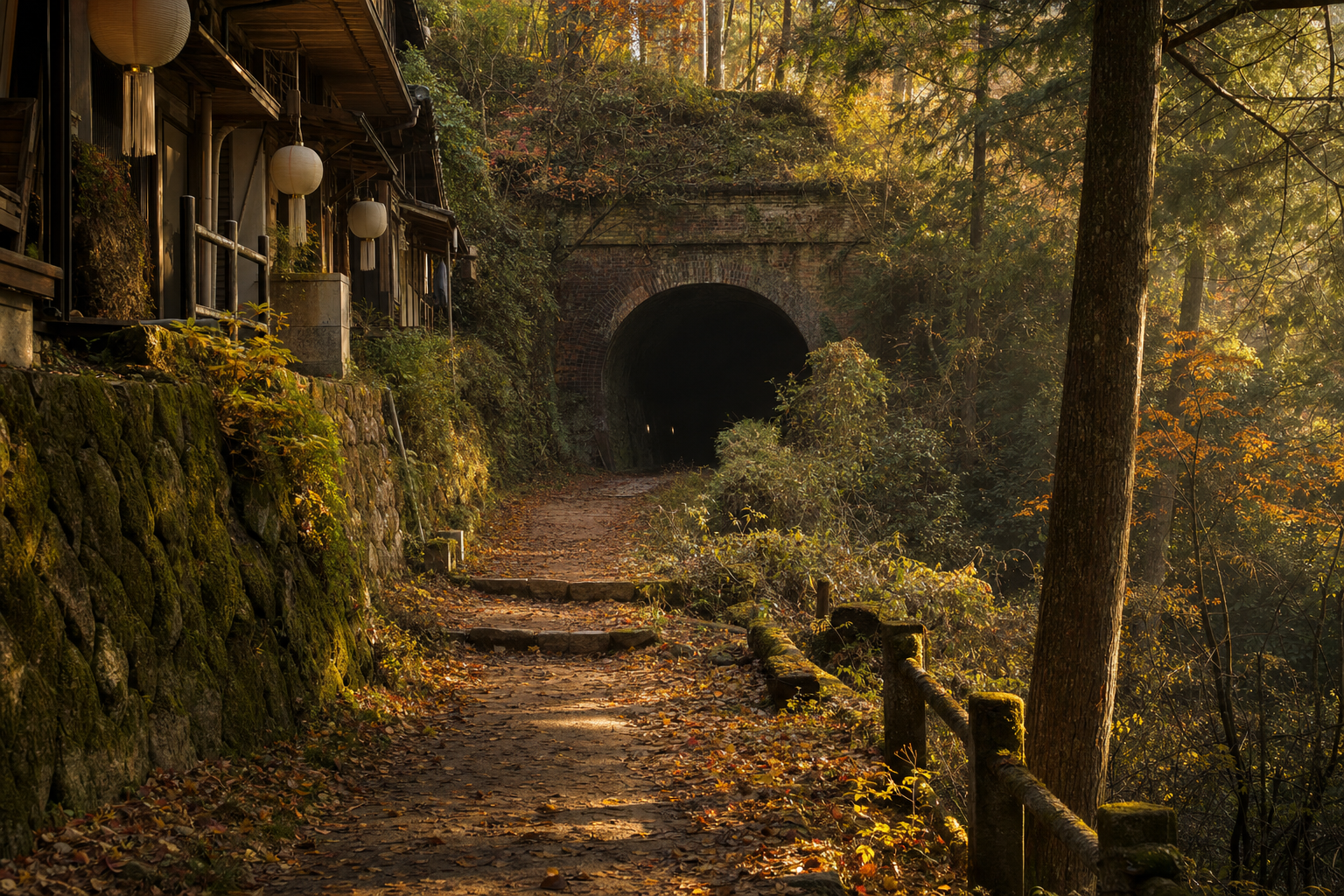
The sound changes first. On the highway side of the mountain, traffic hums through a modern tunnel without slowing. But turn off at the small hamlet of Utsunoya, and within a few steps the engine noise thins out, replaced by water running in a stone gutter, the knock of your own footsteps, and somewhere uphill, a bird you can't yet see. The road — the actual old Tōkaidō, the route that carried daimyō processions and pilgrims between Edo and Kyoto — narrows here to a footpath barely wide enough for two people to pass.
This is Utsunoya Pass, the low mountain crossing between Mariko-juku and Okabe-juku in present-day Shizuoka. On the great map of the fifty-three post stations, it is a small wrinkle. On foot, it is one of the places where the Tōkaidō still feels like what it was: a walking road, made for bodies, not vehicles.
A road older than the road
Travelers were crossing this mountain long before the Tōkaidō was formalized in the Edo period. A narrower, older trail nearby — the famous "narrow ivy path," Tsuta no Hosomichi — appears in classical literature from the Heian era, when crossing Mount Utsu meant pushing through vines in half-darkness. Court poets wrote about the loneliness of it. That anxiety is hard to imagine now, on a bright morning with tea fields visible through the trees, but the land remembers: the pass has always been the moment in the journey when the open coastal plain closes in and the traveler is alone with the mountain.
The hamlet at the foot of the climb grew up to answer that anxiety. Utsunoya's houses stand shoulder to shoulder along the slope, wooden fronts facing the path, many still marked with the old shop names their families carried for generations. For centuries the village sold travelers a specific comfort: ten small dango on a skewer, tied to a local legend about a monk who defeated a shape-shifting ogre on this mountain. Eat the ten dumplings, the story went, and you cross safely. It's a charming tale — and also a perfectly practical business model for a hamlet whose entire livelihood was the fear and hunger of people about to walk over a mountain.
Four tunnels, one path
What makes Utsunoya remarkable is what happened after the walking era ended. In the Meiji period, one of Japan's earliest modern tunnels was driven through this mountain so that traffic could skip the climb — a brick-lined passage you can still walk through today, lamp-lit and cool even in summer, now protected as a cultural property. Then came a Taishō-era tunnel for the motor age. Then a Shōwa one. Then a Heisei one, carrying today's national highway.
Four eras. Four attempts to make the mountain irrelevant. And yet the original footpath over the top was never erased. It sits above all four tunnels like a signature that keeps getting countersigned. Stand at the pass — a modest saddle in the forest, reached in perhaps thirty or forty minutes of steady climbing — and you are walking a line that engineers have been politely detouring around for a hundred and fifty years.
There is something quietly instructive in that. Each tunnel made the crossing faster. None of them made it better. Speed and meaning turned out to be different projects.
Walking it today
The full crossing, from Mariko on the Shizuoka side to Okabe on the Fujieda side, takes a comfortable half day with stops — and the stops are the point. Mariko-juku is still famous for tororo-jiru, grated mountain yam over barley rice, the same dish Hiroshige put in his print of the station and Bashō mentioned in verse; it has been fortifying walkers here for over four centuries. On the far side, Okabe preserves a grand old hatago inn, its dark timbers and steep stairs giving a rare, physical sense of where Edo-period travelers actually slept after a crossing like this one.
Between the two, the hamlet, the climb, the pass, the descent. An hour of forest. No admission gate, no queue. Just the oldest kind of infrastructure Japan has: a maintained path and the assumption that someone will walk it.
The pass as a question
Every generation built its tunnel because every generation had somewhere urgent to be. Fair enough — so do we. But the footpath over Utsunoya survives because enough people, in every one of those generations, decided that the slow way was worth keeping. Walking it, you inherit their decision with your feet.
KAIDO plans journeys along these surviving stretches of the old roads — crossings you can do in a morning, with a proper meal at one end and a quiet stay at the other. If Utsunoya makes you wonder which pass lies nearest your own route, that wondering is the beginning. What does the Way mean to you? Sometimes the honest answer is: an hour on foot, over a mountain that four tunnels could not replace.