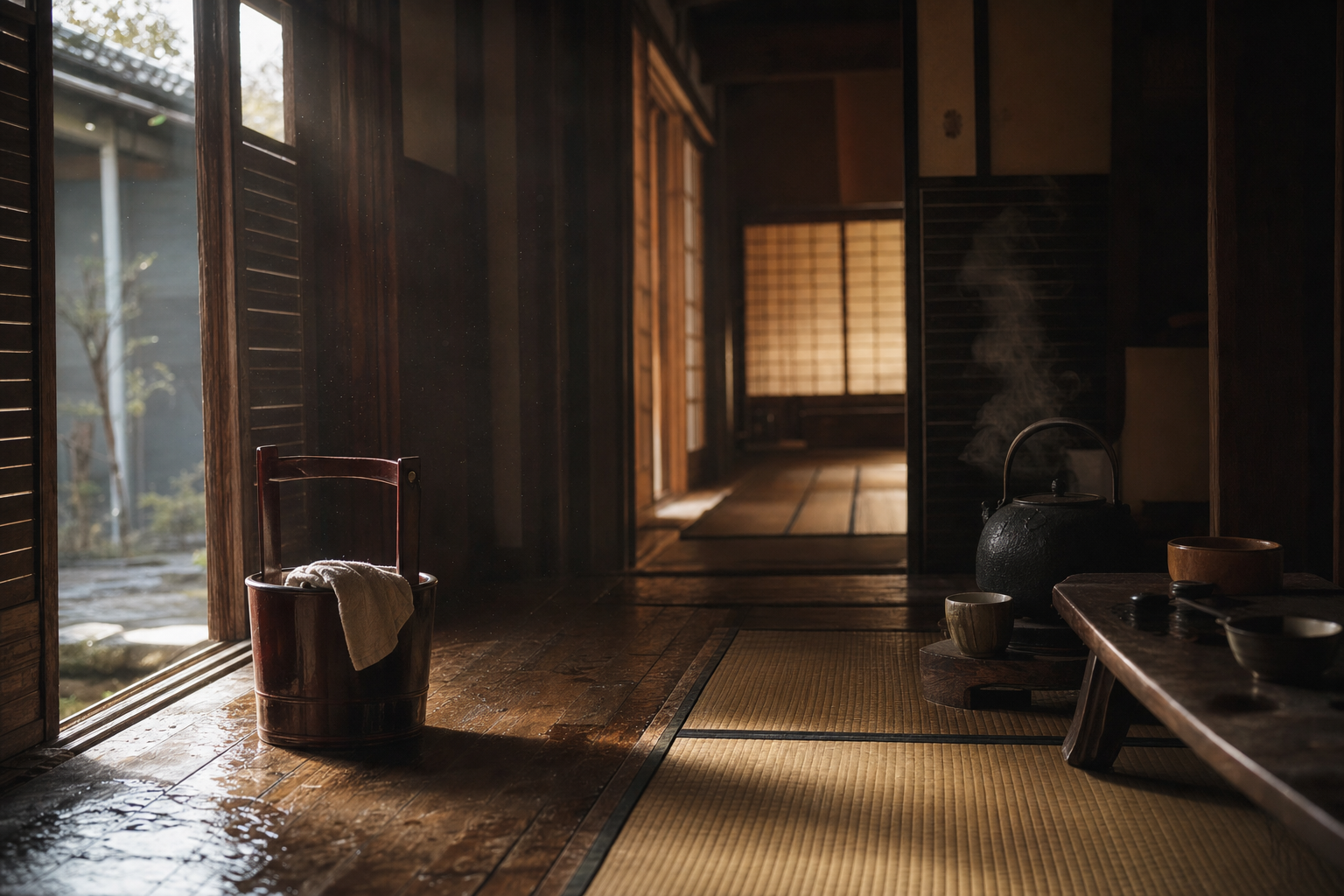
The first sound in the house is wood. At half past five, before the harbor gulls get loud, the innkeeper slides back the amado — the heavy wooden rain shutters that seal a machiya at night. They run along a groove worn smooth by decades of the same motion, and each panel lands in its box at the end of the rail with a soft, familiar knock. One, two, three, four. Grey light comes in sideways, low over the rooftops, and the long narrow house — dark a moment ago — suddenly has a morning inside it.
This is Shimizu, the old port district of Shizuoka, where the Tōkaidō once passed through the post town of Ejiri. Travelers on foot stopped here for centuries, and the town still keeps the shape of that trade: deep, narrow townhouses pressed shoulder to shoulder, built to face the road with a modest front and hold their real life — kitchen, garden, well of light — in the back. A machiya like this one was never designed to impress. It was designed to work, every day, in the same order.
The order of the morning
Shutters first, because the house needs air before anything else. A machiya breathes through its length: open the front, open the small garden doors at the back, and a corridor of moving air runs straight through the building. On a clear morning you can feel it pass — cool, smelling faintly of the sea two streets away.
Then the tatami. The guest room mats are swept along the weave, never against it, with a broom kept only for this. Where the sun will fall later, the innkeeper slides the shoji halfway so the mats warm slowly instead of baking. Tatami is a living surface — rush grass over a core — and it holds moisture from the night. Airing it is not decoration. It is why the room will smell green and dry, not damp, when a guest kneels on it at four in the afternoon and can't quite say why the room feels good.
Last, water. The kettle goes on. Water is carried to the entrance and ladled over the stone step outside the door — uchimizu, the old habit of wetting the threshold. It settles the dust, cools the stone, and darkens it to a deep, welcoming grey. A wet doorstep is an unspoken sentence any passerby in Japan can read: this house is awake, and someone is caring for it.
Why the empty hour matters
Here is the quiet truth of a good inn: the hospitality a guest receives at check-in was actually performed hours earlier, alone, with no one watching. The bow at the entrance is real, but it is the last step of the work, not the first. The first step happened at dawn — a broom moving across a mat in an empty room, done as carefully as if the guest were already sitting there.
The innkeeper of a house like this learned the order from the house itself, and usually from a mother or a grandmother who ran it before. Which shutter sticks in humid weather. Which mat catches the ten o'clock sun. How much water the doorstep takes in August versus January. None of it is written down. It lives in the hands, and it passes the way most real skills pass along the old roads — by standing next to someone and doing it a thousand times.
The road outside
Step out while the doorstep is still wet and the street is nearly empty. A fish delivery van. A neighbor sweeping her own threshold, nodding without stopping. On a clear winter morning, from certain corners of Shimizu, Fuji stands white and close above the roofline — the same mountain Hiroshige put behind this stretch of the Tōkaidō. The travelers changed; the morning didn't. It still belongs to the town's own people and their work, and a guest who wakes early enough is simply allowed to witness it.
Staying inside the routine
This is what we look for in a KAIDO stay: not a building preserved like a museum, but a house still running on its old daily order. If you sleep in a machiya along the Tōkaidō, set an alarm for once in your life on holiday. Come down at six. You won't be served yet — breakfast is an hour away — but you'll hear the shutters, smell the wet stone, and understand something no brochure can explain: that being welcomed begins long before you arrive.
What does the Way mean to you? Sometimes it's not a road at all. Sometimes it's a broom, a bucket, and an hour of quiet work done for someone who is still asleep upstairs.