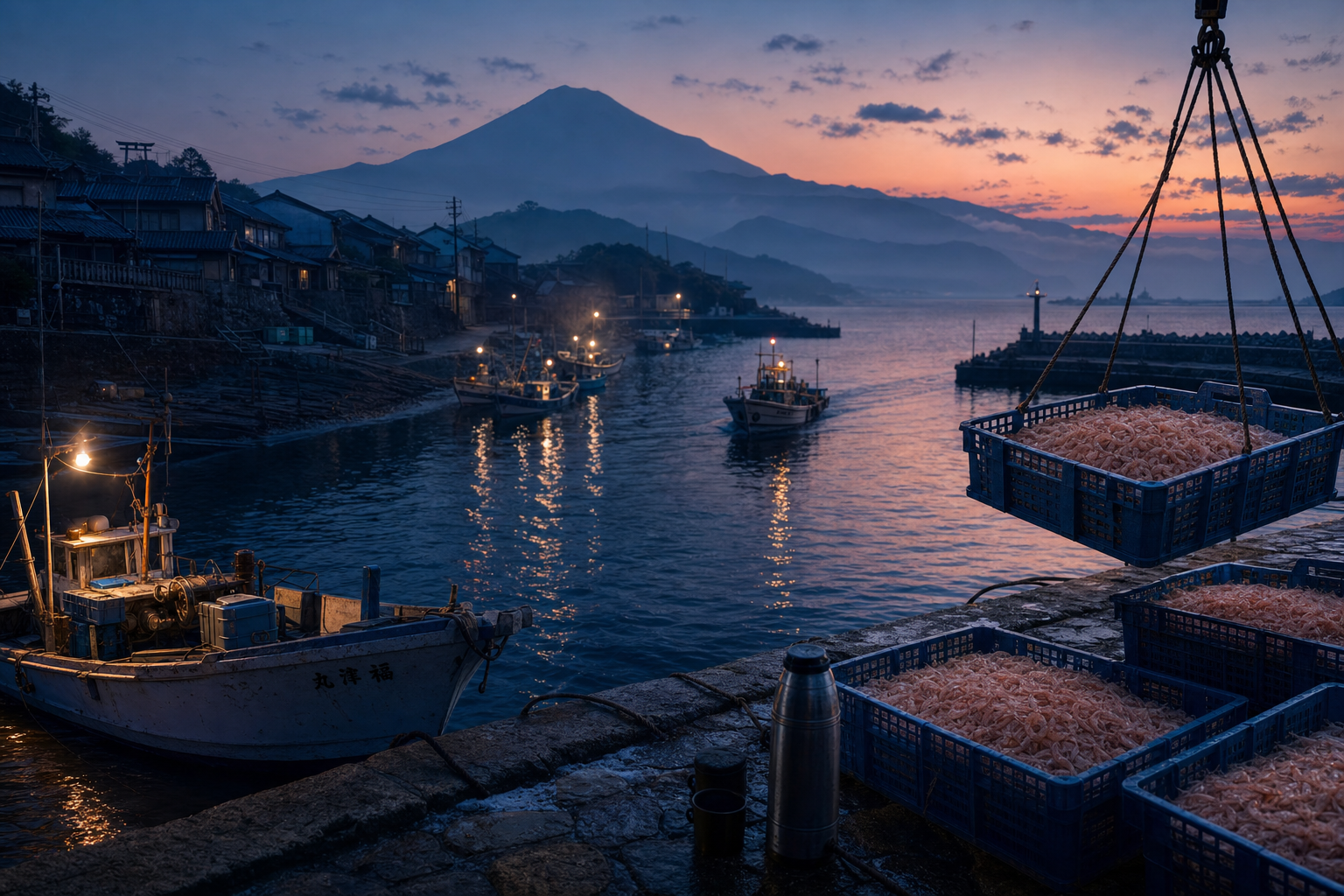
The harbor at Yui is loudest in the dark. Diesel engines idle against the seawall, gulls argue over the masts, and under the sodium lamps the crates come ashore one after another — each one glowing faintly pink, as if the boats had gone out at dusk and brought back a piece of the sunrise early. This is sakura ebi, the sakura shrimp of Suruga Bay, and by the time most travelers wake, the work is already done.
Yui-shuku sits on the old Tōkaidō, the walking road that once linked Edo and Kyoto, the sixteenth of its fifty-three post stations. It is a narrow town by necessity: here the mountains of Satta Pass drop almost straight into the sea, and the road, the houses, and the harbor all share the same thin ribbon of flat land. For centuries, everyone who walked the Tōkaidō had to pass through Yui — and everyone who passed through needed to eat.
A Town Built to Feed Strangers
That was the original job of a post town. Yui existed to give walkers a bed, a bowl, and the strength to climb Satta Pass the next morning — the steep headland just east of town, where the old path still runs high above the water and Mount Fuji stands across the bay. Hiroshige drew that view in his famous series of Tōkaidō prints, and if you walk the pass today, the composition is still recognizable: the sea below, the peak beyond, the road threading between them.
Here is the honest part of the story: the sakura shrimp came later. Commercial fishing for them began in the Meiji era, in the 1890s, well after the age of straw sandals and palanquins had ended. But the town's instinct — catch what the bay gives you, prepare it simply, serve it to whoever arrives hungry — was already two and a half centuries old. The road built the habit. The shrimp simply gave it a new form.
What the Deep Water Gives
Suruga Bay is the deepest bay in Japan, and the sakura shrimp live far down in that cold darkness, rising toward the surface at night. So the fishing happens in the dark, in short seasons in spring and autumn, and the fleet comes home while the town still sleeps. Japan permits sakura shrimp fishing only here, in this one bay, worked from a small number of licensed boats — a deliberately limited harvest, protected so that there will be shrimp next season, and the season after that.
In season, the shrimp are spread outdoors to dry on riverside grounds near the Fuji River, and for a few days the ground itself turns pink — flat fields of coral color with Fuji white above them. It is one of the quietest spectacular sights in Shizuoka, and it lasts only as long as the weather holds.
The Taste of a Walking Road
In town, the shrimp appear the way post-town food always appeared: fast, hot, and honest. The local signature is kakiage — a loose tempura fritter of whole sakura shrimp, fried until the edges shatter and the center stays sweet. You can eat it over rice or with soba, standing practically in the shadow of the old highway. Raw sakura ebi, eaten within hours of landing, tastes faintly of the deep bay itself: clean, cold, a little sweet.
This is what people mean when they say a road shapes a town's table. Yui never developed grand cuisine. It developed traveler's cuisine — food that could be made quickly, from what was nearest, for someone who would be gone by afternoon. The walkers are gone, but the kitchen logic remains, passed from boat to boat and shop to shop.
Walking It Yourself
Yui is an easy stop today — a small station on the JR Tōkaidō line between Shizuoka and Fuji, with the Hiroshige art museum near the site of the old honjin inn. But the town makes most sense on foot. Arrive the evening before. Sleep in the town. Wake early, before the light, and walk east toward Satta Pass as the fishing boats come in below you. From the old path you will see what every Edo-period traveler saw: the bay, the mountain, the thin town that fed them all.
Then come down and eat what the boats brought home. That is the whole lesson of Yui, and it fits in a single bowl.
The Old Roads is an ongoing KAIDO Journal series on the post towns of Japan and the ways of life they still carry. If a pre-dawn harbor and a climb over Satta Pass sound like your kind of morning, our Journey pages can help you plan the walk — and a quiet place to sleep the night before.